
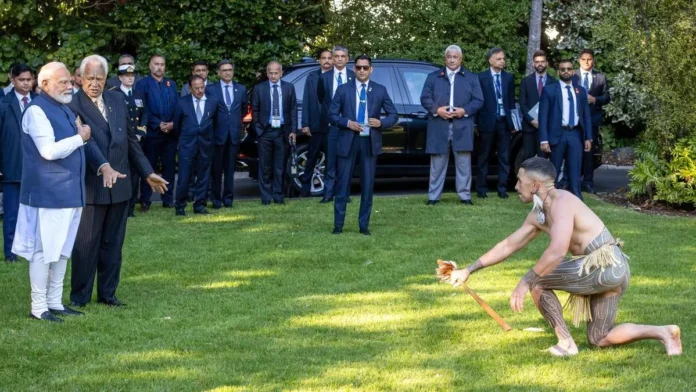
New Zealand and India have elevated their diplomatic relationship to a full “strategic partnership,” a significant upgrade announced during the recent visit of Indian Prime Minister Narendra Modi to Auckland. This enhanced status underscores a deepening alignment between the two nations, driven by shared democratic values, robust people-to-people connections, and mutual interests in the Indo-Pacific region. The move signals a concerted effort to bolster cooperation amidst evolving geopolitical dynamics and potential threats within the Asia-Pacific.
Key Agreements and Security Cooperation
The elevation of ties was formalized during discussions between Prime Minister Modi and his New Zealand counterpart, Christopher Luxon. A joint statement highlighted the shared vision that underpins this strategic partnership. Beyond diplomatic pronouncements, the leaders also advanced security cooperation, signing a defense cooperation arrangement. This agreement is poised to foster greater collaboration on maritime safety and security, reflecting a shared commitment to maintaining stability and addressing common concerns in the strategically vital Indo-Pacific.
Prime Minister Modi’s visit, his first to New Zealand in four decades by an Indian premier, followed a series of engagements in Indonesia and Australia. His itinerary included addressing a large gathering of the Indian diaspora in Auckland, underscoring the significant and growing Indian community in New Zealand.
Immigration and Societal Dynamics
The strengthening of bilateral ties occurs against a backdrop of complex domestic considerations within New Zealand, particularly concerning immigration. The burgeoning Indian population, which numbered approximately 292,000 out of New Zealand’s 5.3 million residents according to the 2023 census, has become a focal point in the nation’s immigration discourse. This demographic shift has, unfortunately, coincided with an increase in reported racial abuse targeting individuals of Indian descent.
Furthermore, the recent free-trade agreement between India and New Zealand has generated some internal friction within New Zealand’s ruling coalition. Political factions, notably Winston Peters’ New Zealand First party, have advocated for more stringent controls on immigration, reflecting broader societal debates about the pace and scale of migration and its impact on national identity and infrastructure.
People-to-People Links as a Foundation
Despite these challenges, the deep-rooted people-to-people links between India and New Zealand remain a cornerstone of the bilateral relationship. The substantial Indian diaspora in New Zealand plays a crucial role in fostering cultural exchange and economic ties. These connections provide a strong foundation upon which the newly established strategic partnership can build, aiming to leverage mutual strengths for shared prosperity and security.
Shared Vision for the Indo-Pacific
The “strategic partnership” designation signifies a mutual recognition of the importance of the Indo-Pacific region to both nations’ futures. Both India and New Zealand are actively seeking to enhance their engagement in this dynamic area, which is increasingly central to global trade, security, and diplomatic initiatives. The agreement to deepen collaboration on maritime safety, in particular, speaks to a shared interest in ensuring freedom of navigation and addressing transnational maritime challenges.
The upgrade in diplomatic status is expected to facilitate more frequent high-level dialogues, coordinated policy approaches, and joint initiatives across a spectrum of areas, including trade, investment, technology, and cultural exchange. It provides a framework for addressing both opportunities and challenges more effectively, reinforcing the idea that New Zealand and India are not merely partners but strategic allies in navigating the complexities of the 21st century.
Looking Ahead
The establishment of a strategic partnership between India and New Zealand marks a significant milestone in their bilateral relations. It reflects a shared commitment to democratic principles and a forward-looking approach to regional and global issues. While navigating the domestic sensitivities surrounding immigration and trade will be crucial, the enhanced diplomatic framework provides a robust platform for deepening cooperation and mutual understanding between the two nations for years to come.