
Scotland’s Striking Form: A Positive Selection Headache for Steve Clarke
Generations of theatre have often suggested a troubled dress rehearsal can foreshadow a triumphant opening night. However, for those associated with the Scotland national football team, such pre-performance jitters have historically offered little comfort. In the lead-up to the delayed Euro 2020, preparations were marked by a narrow one-goal victory in Luxembourg, a prelude that ultimately failed to inspire confidence for the tournament itself. Similarly, two years ago, a strong qualification campaign for Euro 2024 seemed to lose momentum with unconvincing performances against Gibraltar and Finland, raising concerns that the finals had arrived at an inopportune moment. This current juncture, however, feels distinctly different.
Prior to this past weekend, since taking the managerial reins in 2019, Steve Clarke’s Scotland had only managed to score four or more goals in a match on five occasions. Following goalless draws against Japan and the Ivory Coast in March, anxieties about pre-tournament wobbles resurfaced. Yet, the turnaround has been remarkable. Last Saturday’s decisive 4-1 victory over Curacao appeared to instill renewed belief in the squad as they journeyed to Florida. This was then amplified by a commanding four-goal performance against Bolivia in New Jersey, propelling their confidence to new heights.
In the aftermath of the match, Clarke acknowledged that areas for improvement remain, but crucially, the team is addressing these from a position of considerable strength. Analysis indicates that, both physically and psychologically, the squad is in its best condition heading into a major tournament since Clarke’s tenure began. While challenges persist, they are predominantly of a positive nature, a stark contrast to previous finals.
Tactical Clarity and Attacking Prowess
‘Fantastic, fantastic problems,’ Clarke remarked following the comprehensive 4-0 triumph over the South American opponents. One area that appears to have solidified considerably is the team’s formation. After experimenting with 3-5-2, 3-4-2-1, and 4-2-3-1 systems, an established 4-4-2 has seemingly provided the key to recent success. While the side exhibited some vulnerabilities to counterattacks against Curacao, the performance against Bolivia demonstrated a much more robust defensive structure. Clarke’s tactical adjustments in Florida have evidently paid dividends, with players appearing more comfortable and effective in their defensive duties. This newfound tactical solidity empowered the team to attack with significant menace, overwhelming Bolivia with a flurry of first-half goals. This tactical blueprint is widely expected to be employed in the upcoming match against Haiti.
The primary selection quandary now revolves around the starting lineup and the impact players are expected to make from the substitutes’ bench. Historically, Clarke has faced the arduous task of assembling a competitive squad. While some areas still require careful consideration, there is a palpable sense of progress. The manager will undoubtedly face the difficult decision of leaving out players who have strong claims to start, a situation that is ultimately beneficial for team depth and competition.
Depth and Game Management
Given the anticipated challenges of heat and humidity, coupled with the potential for VAR interventions and mandatory water breaks to extend match durations, the strategic use of five substitutes cannot be overstated. The team that finishes the game is becoming as crucial as the one that begins it. The composed game management displayed by a significantly altered second-half lineup against Bolivia, effectively shutting out their opponents, did not go unnoticed by the manager amidst the brilliance of the first-half offensive display.
Easier decisions for Clarke likely lie at either end of the pitch. The defensive pairing of Grant Hanley and Jack Hendry appeared more cohesive against Bolivia than John Souttar and Scott McKenna did in the previous outing. It is anticipated they will retain their places against Haiti, with Aaron Hickey and Andy Robertson assured selections at full-back. While Craig Gordon performed capably in the initial warm-up, the suspicion is that Angus Gunn will retain his goalkeeping position due to the clean sheet he secured behind Hanley and Hendry.
Striker Partnership and Midfield Options
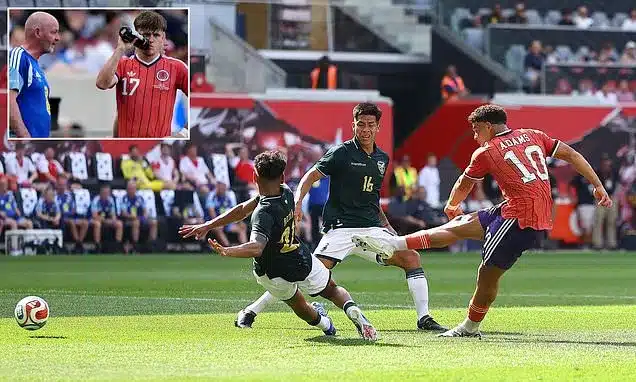
Any lingering doubts regarding Scotland’s most effective attacking partnership were definitively dispelled during the first half. The understanding between Che Adams and Lawrence Shankland was exceptional, with their complementary skill sets proving highly effective. While Lyndon Dykes also performed well alongside Shankland a week prior, Adams’ performance was superior. The duo displayed instinctive and brilliant interplay. After Shankland opened the scoring with a header and Scott McTominay added a second with a drilled effort, Adams contributed two goals himself. At halftime, Scotland was scoring with remarkable ease. Their performance was characterized by patience when required in the heat and ruthlessness in critical moments, delivering a performance that was as impressive as any 45-minute display in recent memory, even in a friendly context against an opponent still recovering from playoff elimination.
As the halftime whistle blew, thoughts inevitably turned to the upcoming fixture. The sight of John McGinn warming up presented a tactical conundrum. It is almost inconceivable that the Aston Villa captain will not start against Haiti, given his significant contributions throughout Clarke’s tenure. However, equally, no player who was part of the near-flawless first-half performance should be overlooked. Regardless of the manager’s decision, some players will undoubtedly feel a sense of disappointment.
McTominay’s inclusion in the starting lineup is also a certainty. His performance was outstanding, effortlessly gliding past Bolivian defenders and showcasing his extensive passing range. Considering Haiti’s reputation as a potent counterattacking side, it would seem imprudent for Clarke not to select a defensive midfielder. Lewis Ferguson delivered an exceptional performance, and Kenny McLean made no errors when he was introduced as a substitute. From a tactical perspective, the difference between the two may be minimal, but one is likely to earn the starting nod.
Winger’s Impact and Midfield Choices
Ben Gannon-Doak’s performance on the right wing was electric. While his display against Curacao lacked a degree of subtlety, against Bolivia he was composed and extremely effective. His pace repeatedly exploited the opposition defense, leading to Adams’ second goal and consistently demonstrating sound decision-making. His inclusion from the start seems essential for a match Scotland must win.
The situation with Ryan Christie exemplifies the ‘fantastic’ selection dilemmas Clarke is facing. The Bournemouth player was excellent in the heat of Harrison, playing a crucial role in the opening goal by setting up the overlapping Robertson. He demonstrated composure, avoided forcing play, and made vital interceptions. There is a possibility he could be deployed in a deeper midfield role, a position he frequently occupies for his club. However, it is more probable that the manager will opt for a specialist defensive midfielder like Ferguson or McLean. Christie would be justified in feeling overlooked if he is the player left out, but he is astute enough to understand that it would not reflect a lack of ability. He would undoubtedly still have a significant role to play from the bench.
As Scotland settles into their training base in Charlotte, numerous factors will still influence Clarke’s final decisions. However, one certainty is that the squad will arrive in Boston later this week with a profound sense of belief, recognizing this as their moment to seize.