
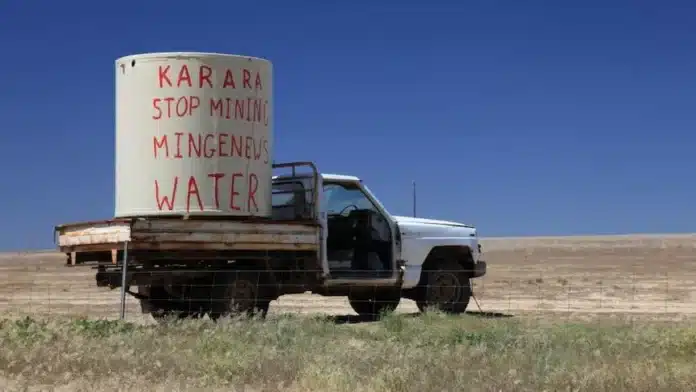
Concerns over water security are mounting in Western Australia’s Mid West region as Karara Mining Limited seeks a significant extension to its magnetite ore operations. The company is requesting approval from the Environmental Protection Authority (EPA) to continue its operations in the Shire of Perenjori until 2048, a move that has prompted local shires to call for a pause in the assessment process to thoroughly investigate potential impacts on vital groundwater supplies.
Substantial Groundwater Allocation Under Scrutiny
Karara Mining’s operation, located approximately 340 kilometres north-east of Perth, has been a source of controversy since its initial approval in 2011. At that time, the company was granted permission to draw a substantial 92 per cent of local groundwater from a section of the Parmelia aquifer. This aquifer is a critical source of potable water for the local community, and its allocation has been a point of unease for residents.
The company currently holds a licence to extract five of the 5.4 gigalitres available in the Mingenew Shire’s portion of the Parmelia aquifer. Hellene McTaggart, Shire President of Mingenew, highlighted the high quality of this water and its importance to the area. “There was a lot of community concern [as] it’s incredibly high-quality water,” Ms. McTaggart stated. “I understand it’s one of, if not the only, drinkable groundwater supplies within the area.”
Adding to existing concerns, Karara Mining secured approval last year to draw an additional gigalitre of groundwater from the Yandanooka bore field until 2035, despite its primary licence set to expire in 2027. “I understand that there are water licensing arrangements… but we are very concerned that such an important natural asset is not being considered in the full environmental impact,” Ms. McTaggart commented.
Call for Assessment Pause Amidst Water Licensing Debate
The Mingenew Shire has formally requested the EPA to halt its assessment of Karara Mining’s proposed 15-year extension. The shire’s primary objective is to conduct a more comprehensive study of the potential consequences for water security. Ms. McTaggart emphasized that water licensing should not be viewed in isolation from broader environmental considerations.
“We understand water licensing is a separate process to this EPA but [groundwater] is such a significant resource and such a huge allocation that we think it cannot be divorced from the overall assessment,” she explained. The shire’s letter to the EPA underscores the belief that the extensive water allocation warrants a more integrated environmental impact review.
Broader Mid West Water Concerns
Water security has been a persistent issue for local governments across the Mid West for the past two decades. Karen Chappel, president of the nearby Morawa Shire, noted the vulnerability of small towns when large-scale projects are granted significant water licences.
“The supply of water to our regional towns has been a concern for all of the local governments… in the last 20 years,” Ms. Chappel said. “But when mining came on board and the licences [were] being given to the likes of the local mining company to help with their project, it really made our small towns very vulnerable.” She added that the substantial water allocation for mining leaves limited capacity for community, town, and agricultural use.
While welcoming industry, local councils remain cautious. “We welcome industry, but we also have to remember that water is a finite resource and some of our communities get their water from different aquifers,” Ms. Chappel stated. “So small local governments are obviously concerned as to the impact all of these [water] licences have on the community.”
Regulatory Oversight and Future Implications
A spokesperson for the Department of Water and Environmental Regulation (DWER) indicated that water licences are evaluated based on a “range of factors.” The department stated its commitment to sustainable resource management to meet government and community expectations. “DWER will subsequently review and amend water licences where required to ensure resources are being managed sustainably to meet government and community expectations,” the spokesperson confirmed.
While water licensing operates under a separate legislative framework from the EPA, the DWER acknowledged the interconnectedness of both processes in considering water impacts. “Both regulatory processes have a role to consider potential impacts and management associated with water extraction,” the spokesperson noted. The EPA may also seek technical input from DWER regarding water resource regulation.
Karara Mining Limited has not yet responded to inquiries regarding its water licensing agreements and the community’s concerns.